
THE PROBLEM
Nearly half of children in Hawai‘i live in households experiencing financial hardship. While almost 1 in 8 are in poverty, an additional 3-in10 families in Hawaii aren’t officially poor but still don’t earn enough to afford the basic life essentials.
Many working-age families are choosing to move to the mainland because of the high cost of living here.
For example, the cost of child and dependent care in Hawai'i has skyrocketed. With the average cost of child care in Hawaiʻi exceeding $13,000 per year, families need more support.
That’s where tax credits come in. They help people keep more of their hard-earned money, and when targeted for lower- to middle-income families, help reduce financial hardship.
THE CDCTC CAN HELP
The Child and Dependent Care Tax Credit (CDCTC) is meant to help with child and dependent care expenses, but it currently is so limited that it can't provide the amount of support that parents need. We need to make the CDCTC truly reflect the economic reality of working families.
We're pushing for a CDCTC Fix (HB2007) (SB2683) to increase the percent of care expenses that can be claimed, allowing working families to get more badly-needed help with their child and dependent care costs.
In 2023, our lawmakers took an important first step to boost the CDCTC. They more than quadrupled the maximum amount that taxpayers can claim for child and dependent care expenses, from $2,400 for one child/dependent to $10,000 (and from $4,800 for two or more dependents to $20,000).
However, they did not increase the maximum percent of care expenses that can be claimed, which is currently capped between 25% for those earning less than $25,000 per year to 15% for those earning more than $50,000.
Such a low cap makes it almost impossible for families to access the full amount of the credit. For example. if a family earns more than $50,000 per year and has pre-K tuition of $10,000, they can claim only $1,500 under the current cap.
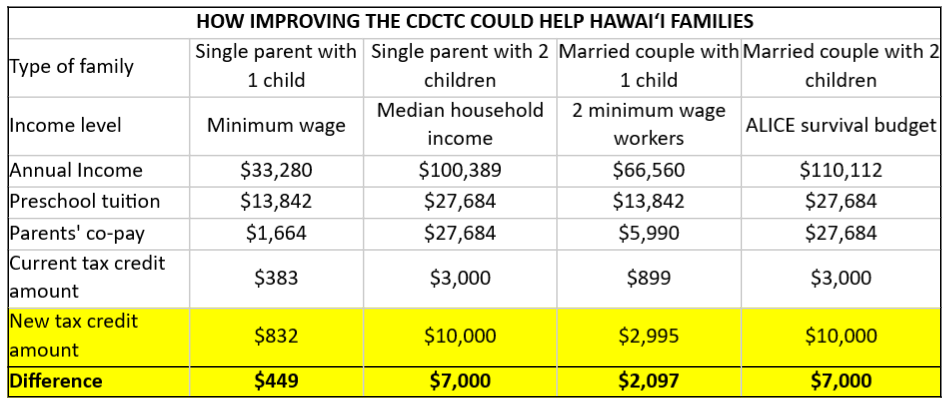
To allow more working families to benefit from the increase that lawmakers passed in 2023, we need to raise the cap on the percent of care expenses that can be claimed with the CDCTC. We should raise the cap to 50% of care expenses for those earning up to $150,000, stepping down to 25% for those earning at least $225,000.
The table below shows how this improvement to the CDCTC would help different types of families in Hawai‘i:
 Helping families afford to enroll their keiki in child care programs also reaps benefits for their parents and our community in other ways:
Full-time child care programs allow parents to obtain stable employment, which increases the economic well-being of the family as a whole.
Research shows that expansions of the CDCTC lead to parents' increased labor force participation in both single-parent and married-couple households.
Such labor force participation rises especially among younger mothers, which leads to positive effects on their future career prospects and wages.
Providing $1 of tax relief to a household via the CDCTC will almost certainly cost the state less than $1 because of the resulting increases in labor force participation.
In addition, early learning programs facilitate the academic and social development of young children and should be supported:
Research on the benefits of quality early learning programs indicates that for every $1 invested in quality learning programs, society saves $4 to $8 on remedial classes, special education, welfare programs, and criminal justice costs.